
 Alpha Breaking
Inflation Fears Are Overblown - Jun 30
Share this article
Spread the word on social media
The Big Picture
Inflation fears are overblown, and that matters for your portfolio right now. MarketWatch argues that headline anxiety about inflation and a string of aggressive Fed hikes may be misplaced, a view that favors risk assets and re‑rates certain sectors.
Investors should note the context: the article highlights a lower inflation signal and a softer hawkish posture from Fed commentary. Those dynamics can change portfolio beta and where you look for valuation opportunities.
What's Happening
MarketWatch lays out the core claim that inflation is not as high as many fear and that Federal Reserve hawkishness looks less certain than headlines imply. Analysts and commentators referenced in the piece point to several data points used in valuation and policy assessments.
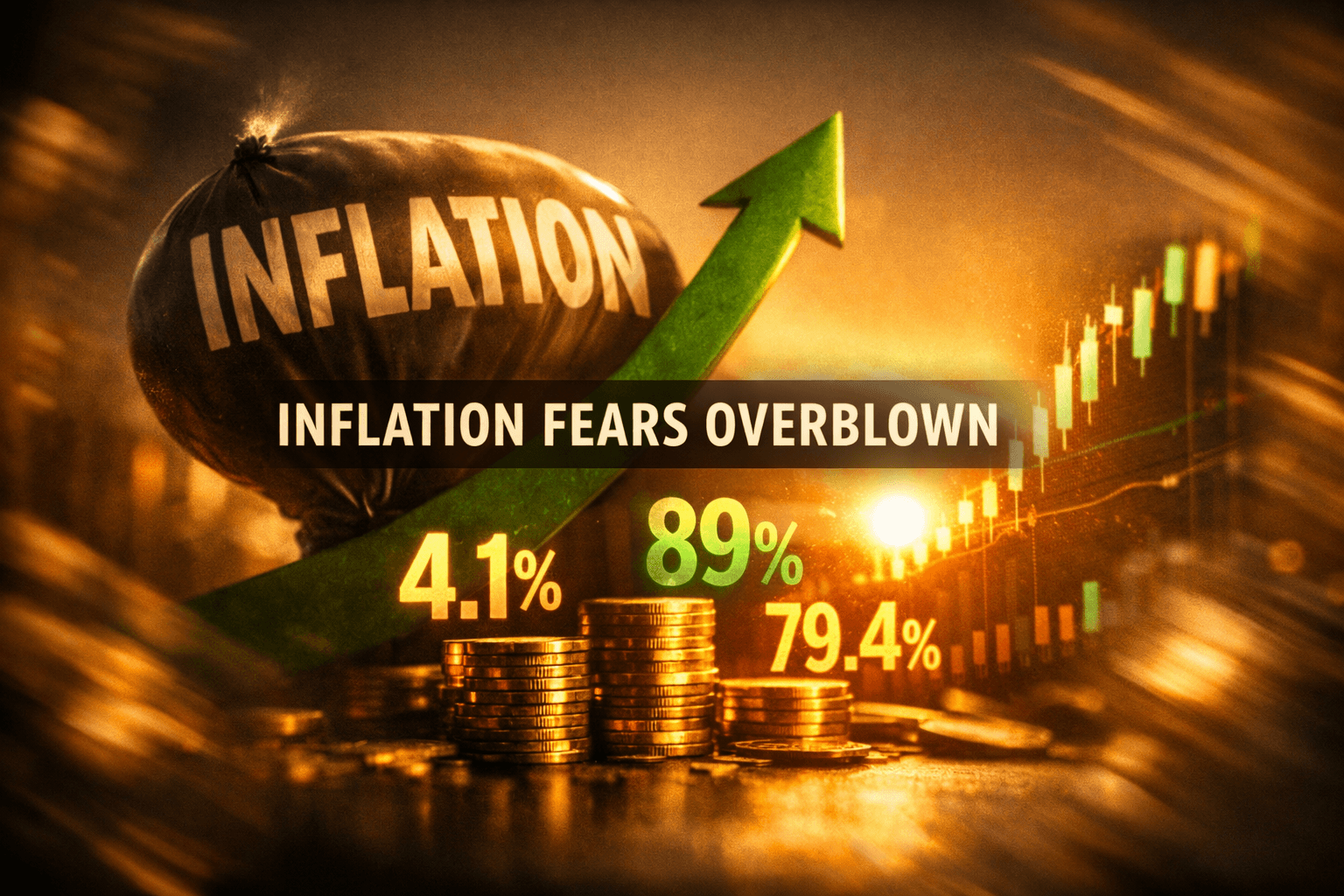
- 4.1% - cited as a key inflation-related figure used in current analysis and market interpretation.
- 89% - included among data points relevant to investor confidence and risk appetite.
- 79.4% - another supplied metric used for valuation cross-checks across sectors.
- Jun 30, 2026 - today's date, underscoring the timeliness of the argument and the need to reassess positioning now.
Each of these numbers matters because they feed into valuation models, expected discount rates, and the probability investors assign to future Fed tightening. The piece specifically notes that Fed Chair signals can appear more hawkish than the underlying data support, a gap that creates opportunity if markets rerate expectations.
Why It Matters For Your Portfolio
If inflation is indeed lower than feared and Fed rhetoric is more show than substance, the cost of capital for equities may stay lower for longer. That tends to benefit growth and long-duration assets where valuations are highly sensitive to discount rates.
Who should care: growth investors and momentum traders looking for continued multiple expansion, plus valuation-driven investors who can use the reduced rate-hike risk to buy selective cyclicals. Income investors may see less upside in short-duration fixed income if rates hold steady but should monitor yield curves closely. Analysts note that a softer Fed outlook can lift $AAPL and $NVDA styled tech exposure and support semiconductor and AI-related sectors, though sector reactions will vary by fundamentals.
Risks To Consider
- Persistent or reaccelerating inflation: If inflation prints reaccelerate beyond the lower signals cited, the Fed could pivot to a tighter path and markets would quickly reprioritize risk.
- Policy misread: Fed communication can change rapidly; what looks like a softer stance now could harden if labor or wage data surprise, compressing equity multiples.
- Valuation sensitivity: Growth stocks that benefit most from lower rates are also most sensitive to any reversal, creating higher downside if the rate outlook shifts.
What To Watch Next
Data and commentary will determine whether the view that inflation fears are overblown gains traction. Investors should track incoming prints and Fed-speak to validate the softer-hawk narrative.
- Upcoming inflation prints and price indices, which will confirm or refute the 4.1% signal cited in current analysis.
- Fed speeches and minutes, which will show whether the apparent hawkish posture persists or softens further.
- Valuation metrics across sectors, especially price-to-earnings and free cash flow yields for growth names versus cyclicals.
The Bottom Line
- Inflation fears are overblown in current commentary, and the Fed may be less hawkish than headlines suggest, a dynamic that can support equity multiples.
- Key data points such as 4.1%, 89% and 79.4% are being used to reassess risk and valuation; watch how incoming economic prints compare to these signals.
- Growth and long-duration assets could benefit if the lower-inflation view holds, but they remain vulnerable to a policy pivot.
- Reassess positions based on new inflation prints and Fed communication rather than on prevailing sentiment alone; analysts note that selective reallocation may be warranted as data confirm trends.
- Use valuation filters and multiple data points in your analysis, rather than relying on a single headline, before changing exposure.
FAQ
Q: How should I interpret the claim that inflation fears are overblown?
A: The phrase reflects reporting that current inflation signals may be lower than commonly feared and that some Fed commentary appears more hawkish than warranted by the data. Investors should watch incoming price data to see if the lower-inflation view holds.
Q: Which types of stocks are most sensitive to a softer Fed outlook?
A: Long-duration growth names and high-multiple tech stocks tend to be most sensitive because lower expected rates reduce their discount rates. Valuation-driven investors will look at P/E and cash-flow yields to decide where to adjust exposure.
Q: What metrics should I monitor to validate this thesis?
A: Track core inflation measures, wage growth, and Fed communications. Also monitor valuation metrics across sectors and the yield curve to see how risk premiums and discount rates are evolving.