
 Alpha Breaking
AI's Supply Chain Is Maxed Out. Delays Are the New Normal
Share this article
Spread the word on social media
The New Normal
Here's a number that tells you where we are in the AI buildout. A standard 100G transceiver — the kind enterprise networks have bought for years — ships in 8 to 14 weeks. The 800G and 1.6T parts that AI clusters actually need? Lead times are running past 40 weeks. Same industry, same year. The difference is what the part plugs into.
This isn't a chip shortage in the pandemic sense, where everything got scarce at once. It's surgical. Demand from AI data centers has maxed out a specific set of production lines — advanced packaging, high-bandwidth memory, laser chips — and everything downstream of those lines now waits. Everyone. There's no name in this supply chain, from Nvidia $NVDA on down, that ships on time when a link upstream slips.
The bottleneck won't sit still
What makes this cycle different is that the constraint keeps moving. Two years ago the choke point was TSMC's $TSM CoWoS packaging — the process that bonds memory stacks onto GPU dies. TSMC's CEO still calls that capacity sold out into 2026, with Nvidia alone consuming roughly 60% of the output. As packaging capacity expands, the squeeze relocates upstream to the HBM memory itself, which only three companies make and none can ramp quickly. Nvidia's own CFO has said customer forecasts point to demand roughly doubling while supply caps growth well short of that.
And behind the memory sits the photonics layer. LightCounting's April forecast — the closest thing this industry has to a scoreboard — says transceiver demand is running about 30% above supply, with growth limited by the production capacity of InP laser chips. Whack one mole, another one surfaces. That's why lead times stay long even as individual chokepoints ease.
Don't take our word for it — take theirs
The people running these companies are saying it out loud, on earnings calls, under securities law. Lumentum $LITE CEO Michael Hurlston: the company is undershipping customer demand by around 30%, and even after adding 20% more capacity, the imbalance got wider. Lumentum's EML laser capacity is locked under long-term agreements through calendar 2027 — customers who want more than their contracts cover pay premium prices, and customers without contracts risk losing supply priority entirely.
Coherent $COHR tells the same story from a different seat. Morgan Stanley's read on its results: AI orders are strong, but backlogs keep accumulating because of InP supply-chain bottlenecks, and revenue recognition isn't accelerating to match. Orders booked years out. Production lines expanding one at a time. TrendForce projects the AI transceiver market growing 57% this year to $26 billion — and names component shortages, not demand, as the primary limit on how fast anyone can expand.
A cluster is a convoy
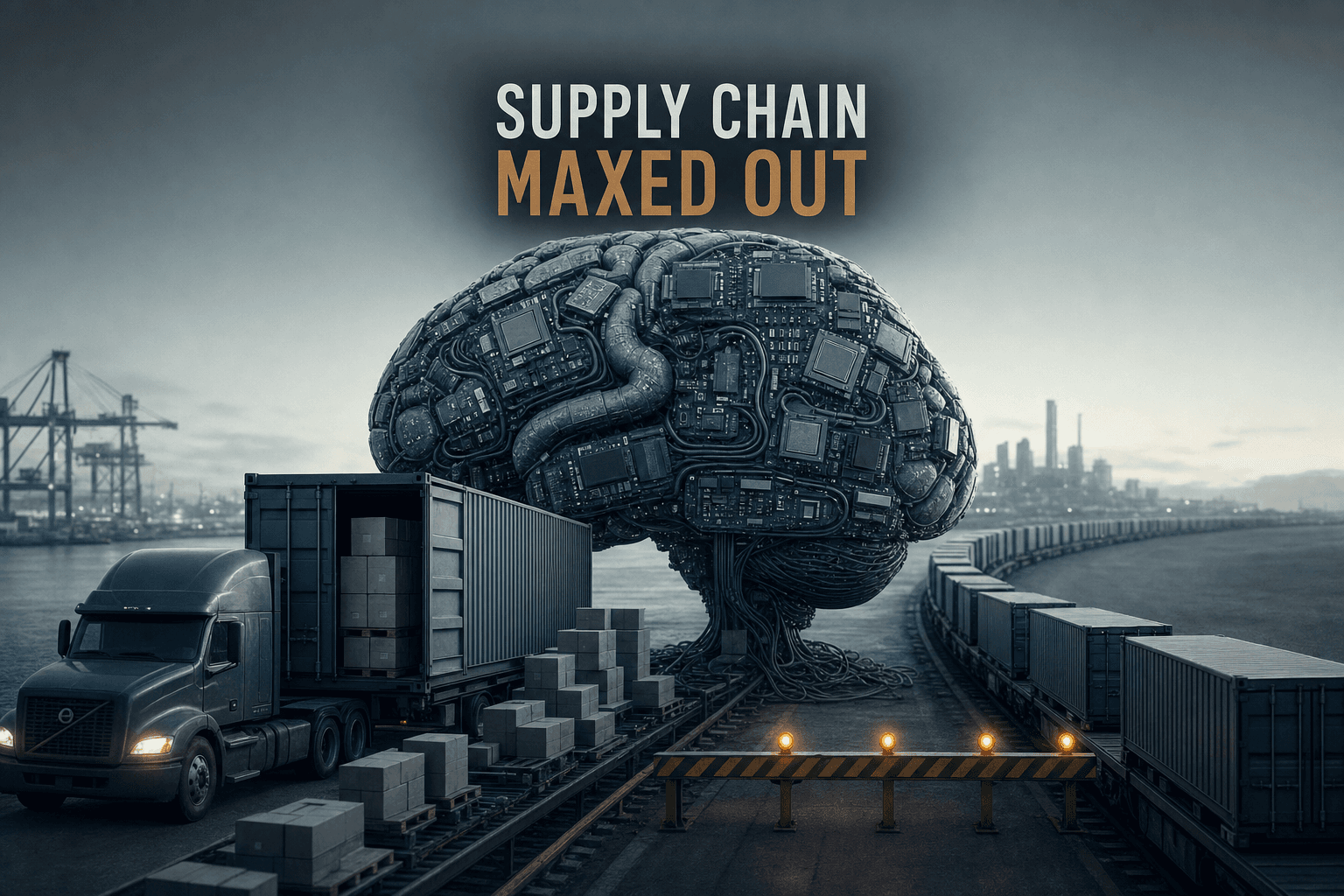
Here's the part most coverage misses. An AI cluster isn't a pile of independent parts — it's a convoy that moves at the speed of its slowest truck. GPUs without transceivers are expensive paperweights. Transceivers without GPUs to connect are inventory. LightCounting makes the point directly: even a minor glitch in GPU supply reduces demand for everything else in the cluster, and if GPU output surprises to the upside, transceiver shortages stretch into 2027.
It cuts the other way too. Analysts covering the optics names note that tight CoWoS packaging has indirectly dragged optical module delivery schedules, because GPU delivery and optics deploy together. A slip anywhere in the chain shows up everywhere in the chain. That's not a bug in any one company's execution. It's the physics of building this much infrastructure this fast.
How to read a delay
Which brings us to the practical takeaway for anyone watching this sector: recalibrate what a delivery slip means. In a normal market, a missed ship date is a company-specific red flag. In this market, it's usually the supply chain talking. The whole industry is running at redline — capacity sold out, order books stretching to 2028, suppliers openly telling their biggest customers they can't have what they want when they want it.
The flip side is just as important. Constraint is why pricing has held up across this group, why long-term agreements have replaced spot orders, and why the selloffs that do hit these names keep coming from macro, not from demand. Companies don't get pricing power in markets with slack in them.
So when the next delivery date slips somewhere in the AI supply chain — and one will — ask the right question. Not "what's wrong with this company," but "which truck in the convoy hit traffic." For the next couple of years at least, that'll be the honest answer far more often than not.